
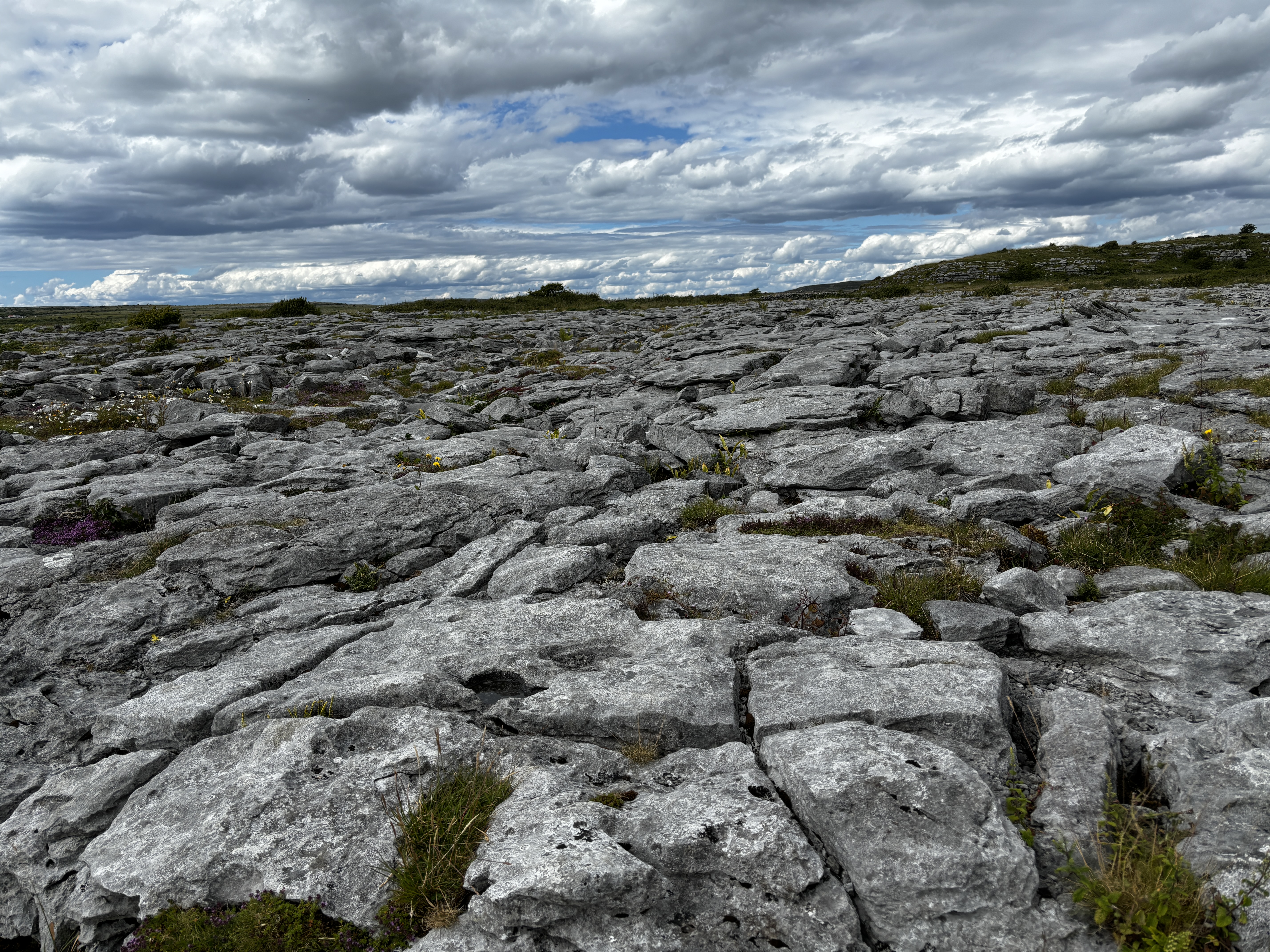
Limestone is fascinating. Over the years we have seen many limestone rock formations, including a month ago at The Burren in Co. Clare, Ireland then Ha Long Bay in Vietnam in October 2023 and Yangshuo in China in July 2021. The Vietnamese and Chinese formations are similar but the formations in Ireland and also Madagascar are very different from the others and indeed each other. The Irish Burren is flat and is one of the best examples of glacio-karst landscapes in the world. The grykes (crevices) and clints are easily recognisable and the grykes have their own floral growing in them. The karst formations that I have seen in Asia are different. Karsts here are mountainous compare to the flatness of The Burren. I am not a geologist but effectively the limestone formed many million years ago and due to climate change over this period and erosion due to rain and sea Ha Long Bay is what it is today (this should never be quoted for research!) Yangshuo karsts are similar but without the sea.


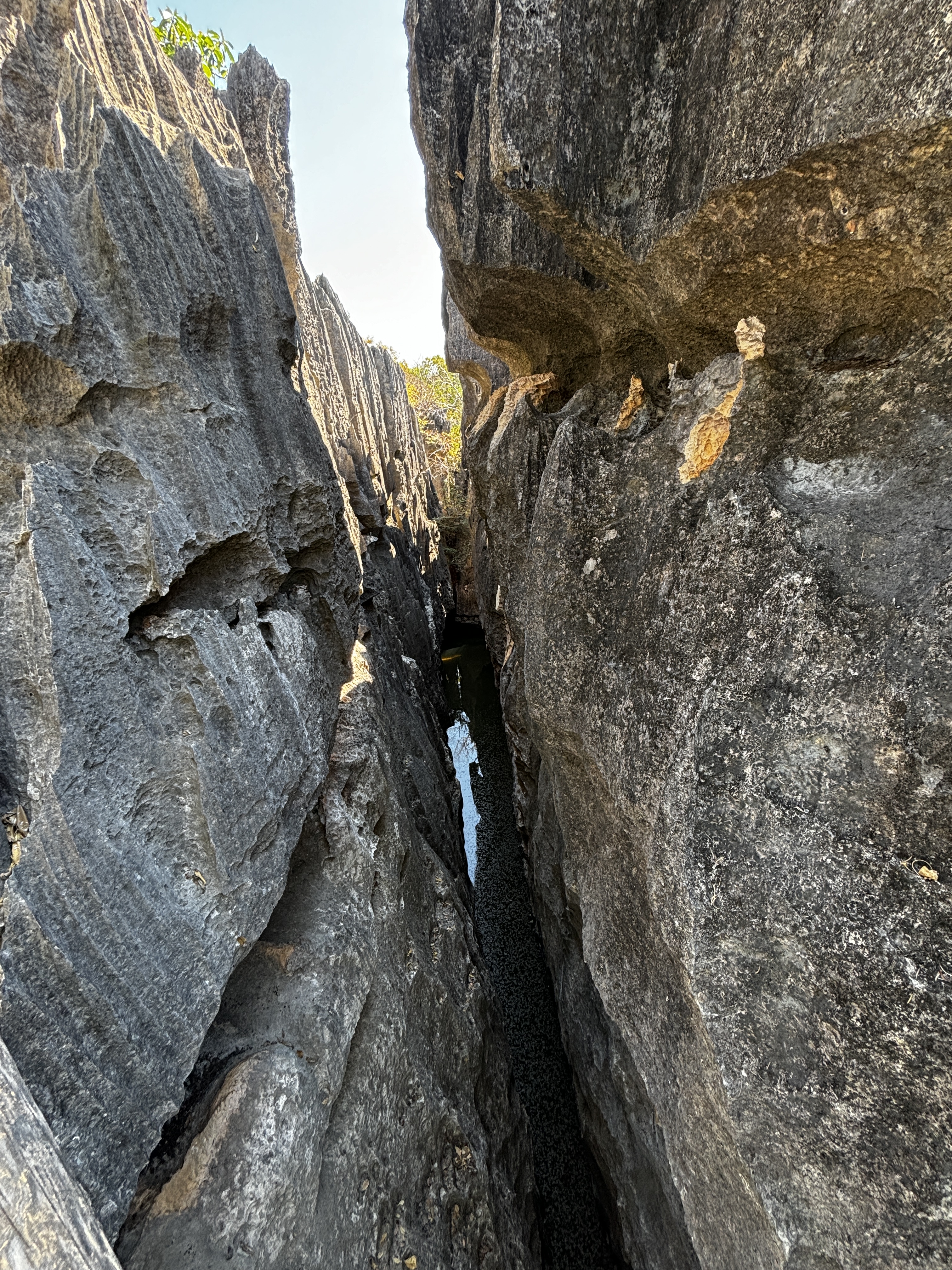
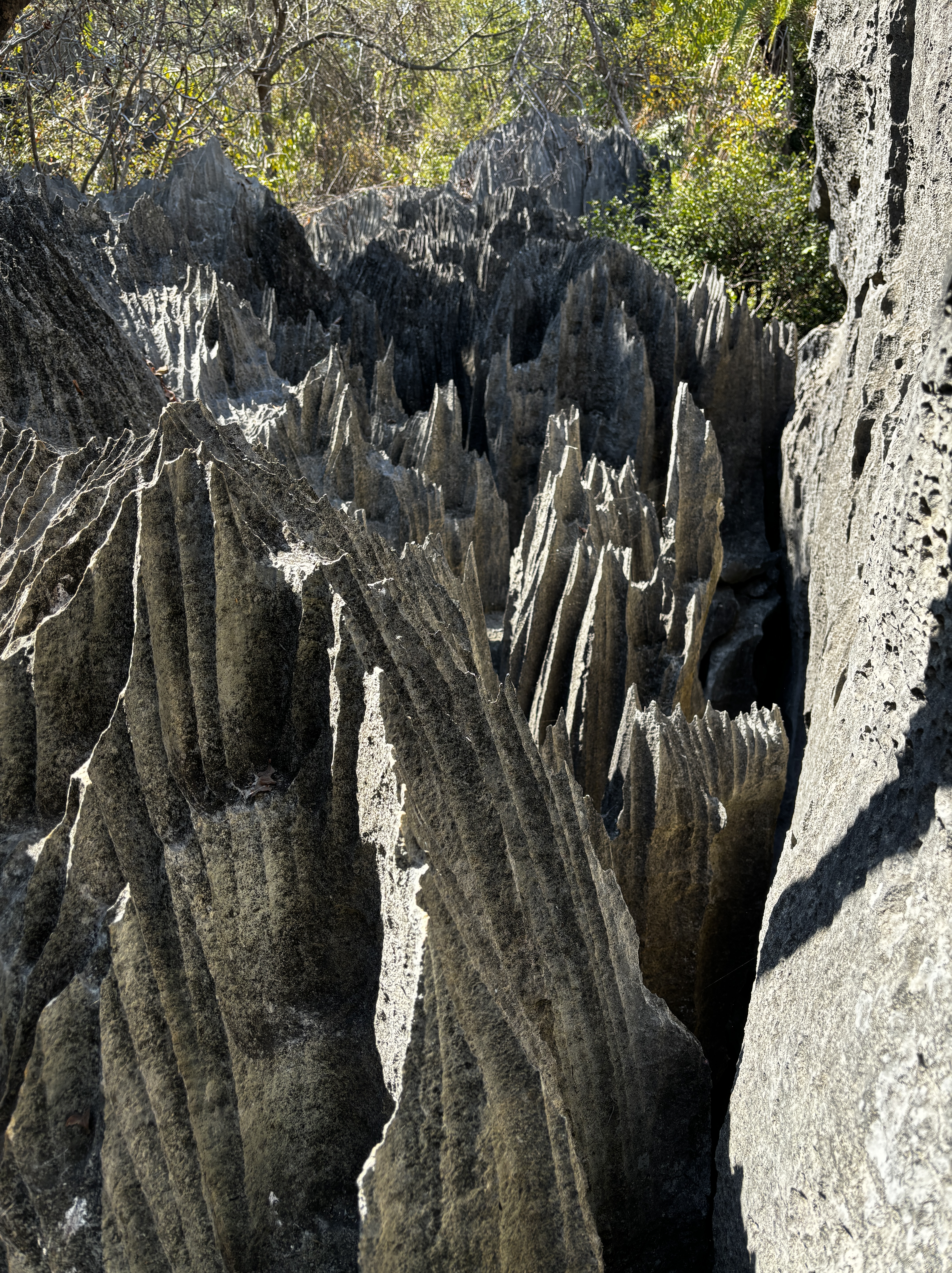
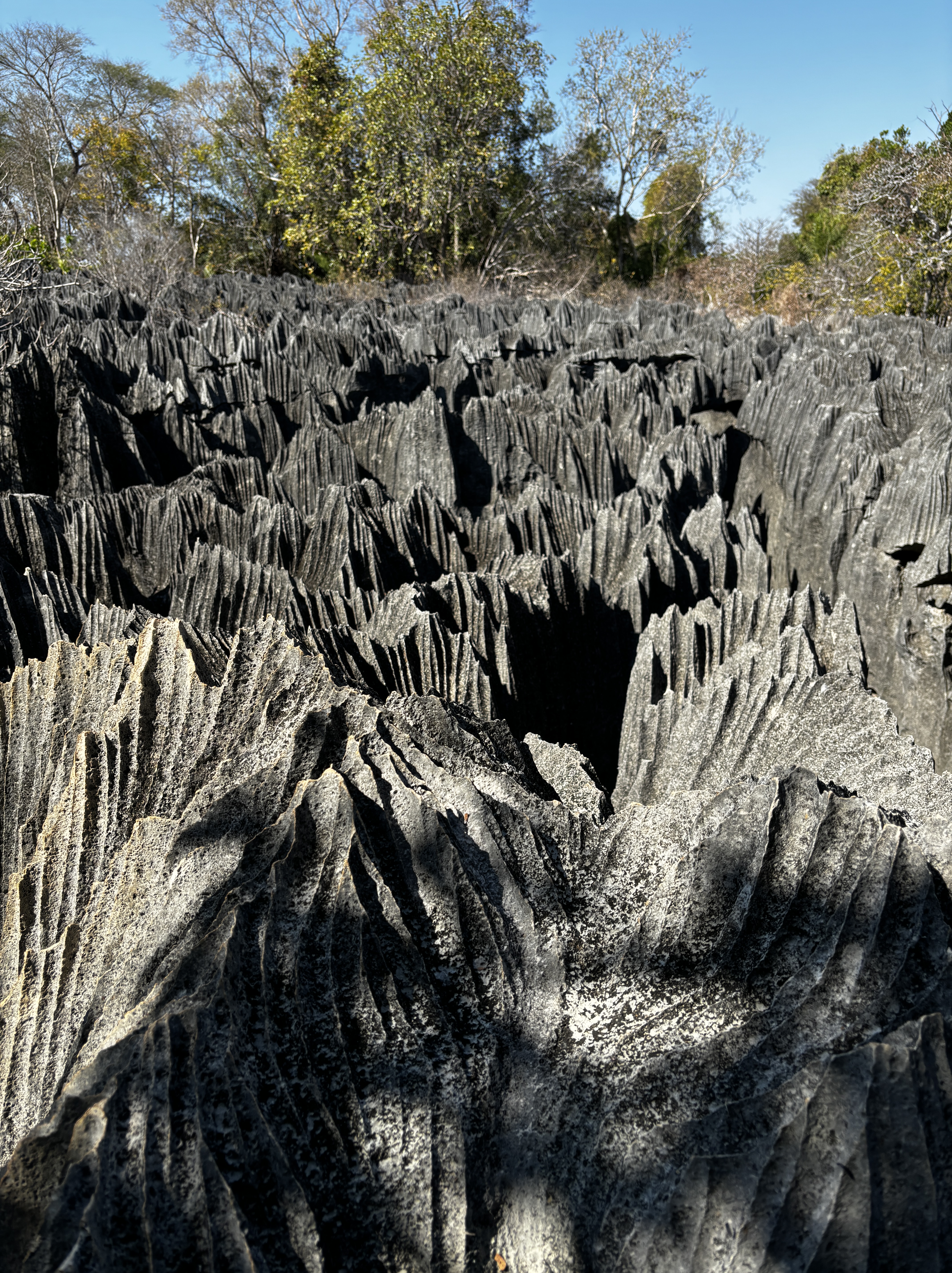
The limestone formations that we saw in Madagascar were very different from the three aforementioned ones. The Tsingy is a mass of spearlike pointed rocks. Formed under a Jurassic lagoon, with tectonic movement the limestone appeared and the grooves have formed over time with monsoon rains. There is a similar karst formation in Kunming, China known as the Stone Forest – but as I haven’t been I can’t say how similar or otherwise it is.
Tsingy

There is the Little Tsingy and the Great Tsingy. We were all tested on our ability on the little one before being allowed to do the big one. It is fair to say that all of us wanted to do both, but not everyone did the small one due to health that morning and while we all went to the big one, three of our group decided not to do it or where advised against it.
The Little Tsingy
Tsingy in Malagasy is “the place where one cannot go barefoot” or simply put – you have to walk on your tiptoes. Thankfully no one did have to tiptoe or walk barefoot. Walking shoes or boots were donned and while some of us chose long sleeves and trousers for our excursions others diced with the sharp pinnacles and wore short sleeves and shorts.
Both Tsingys are located in northwest Madagascar in the Tsingy de Bemaraha National Park a UNESCO World Heritage Site. Pre-Covid visitor levels were at 22,000 per year and while the level is slowly increasing it is only sitting at around 8,000 just now. We were glad for our quiet days as it meant no one felt rushed; the phrase of the two days was definitely “mora mora” – slowly slowly.
We got off the canoe in the village and what surprised me was that the Little Tsingy was just behind the village. The circuit of the Little Tsingy was 1.7km and the 3.1km at the Great Tsingy. The distances nor the timings really didn’t matter as Barnabas had said we would could be out for eight hours at the Great Tsingy.
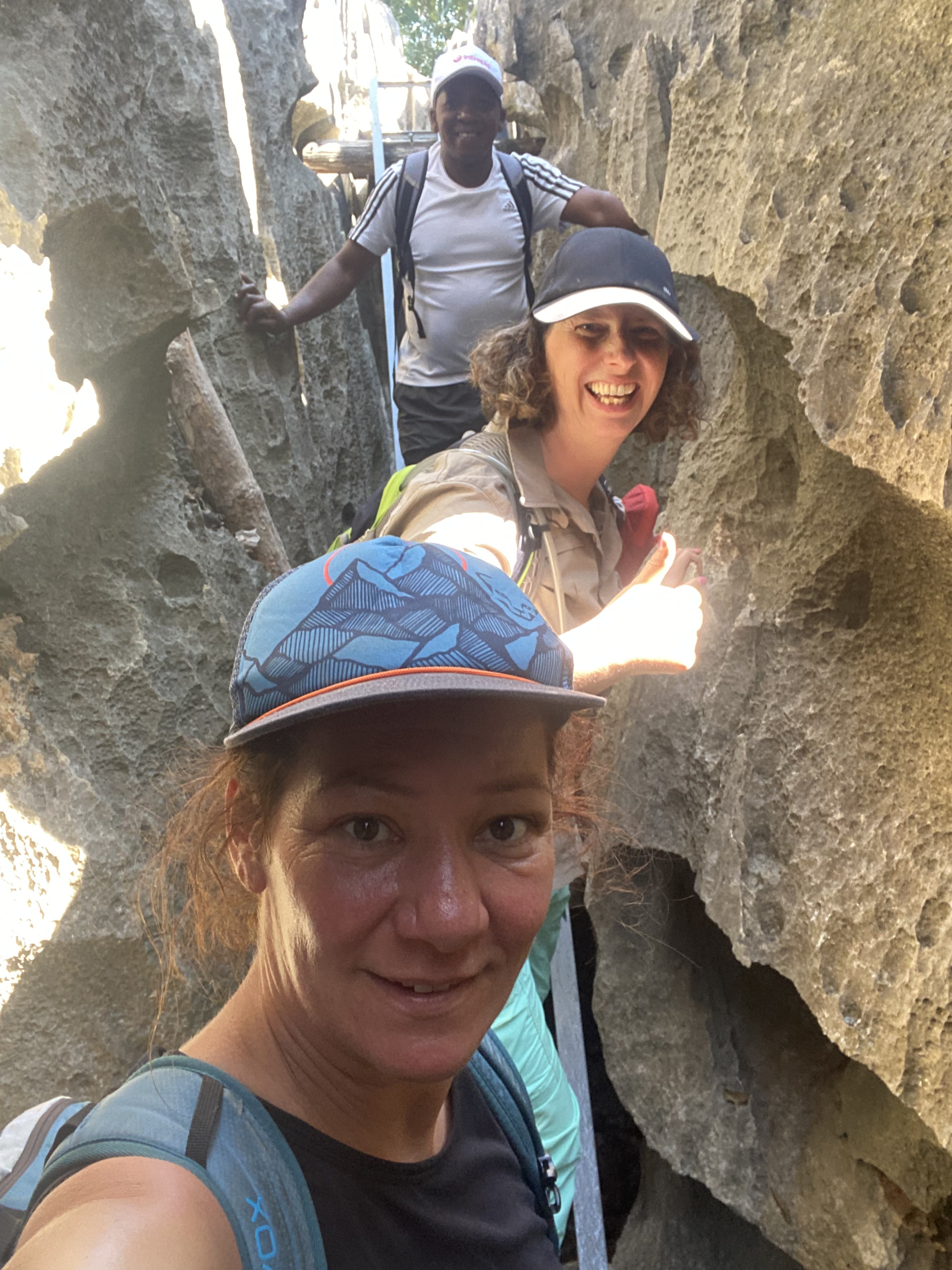
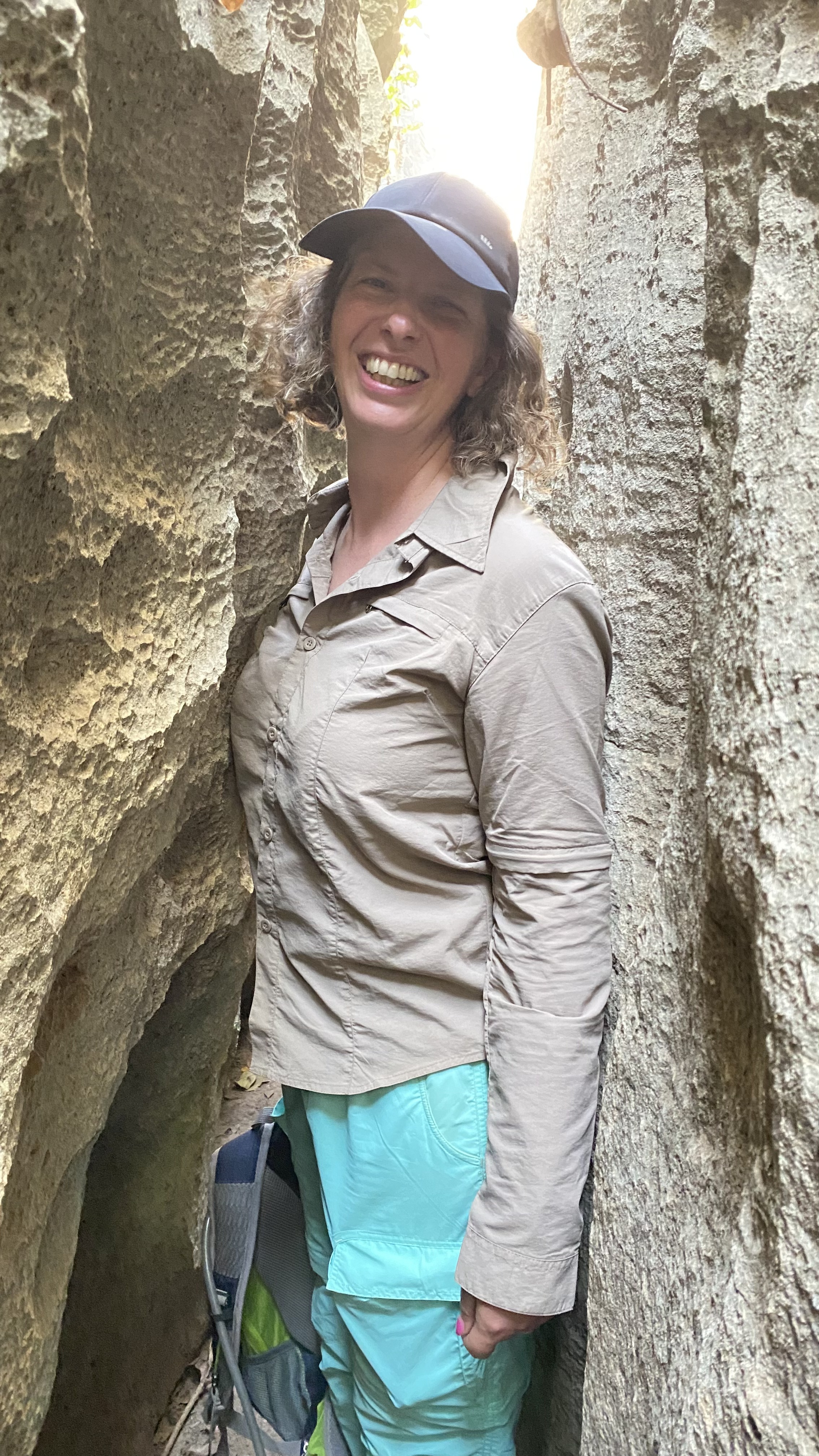
As we headed off, we were like a family of ducks all in a line, accompanied by Barnabas who was at the rear, one local guide was at the front, and the other in the middle. The floor of the Tsingy was cool and welcoming, but once we climbed up into the heart of the Tsingys the sun was strong.
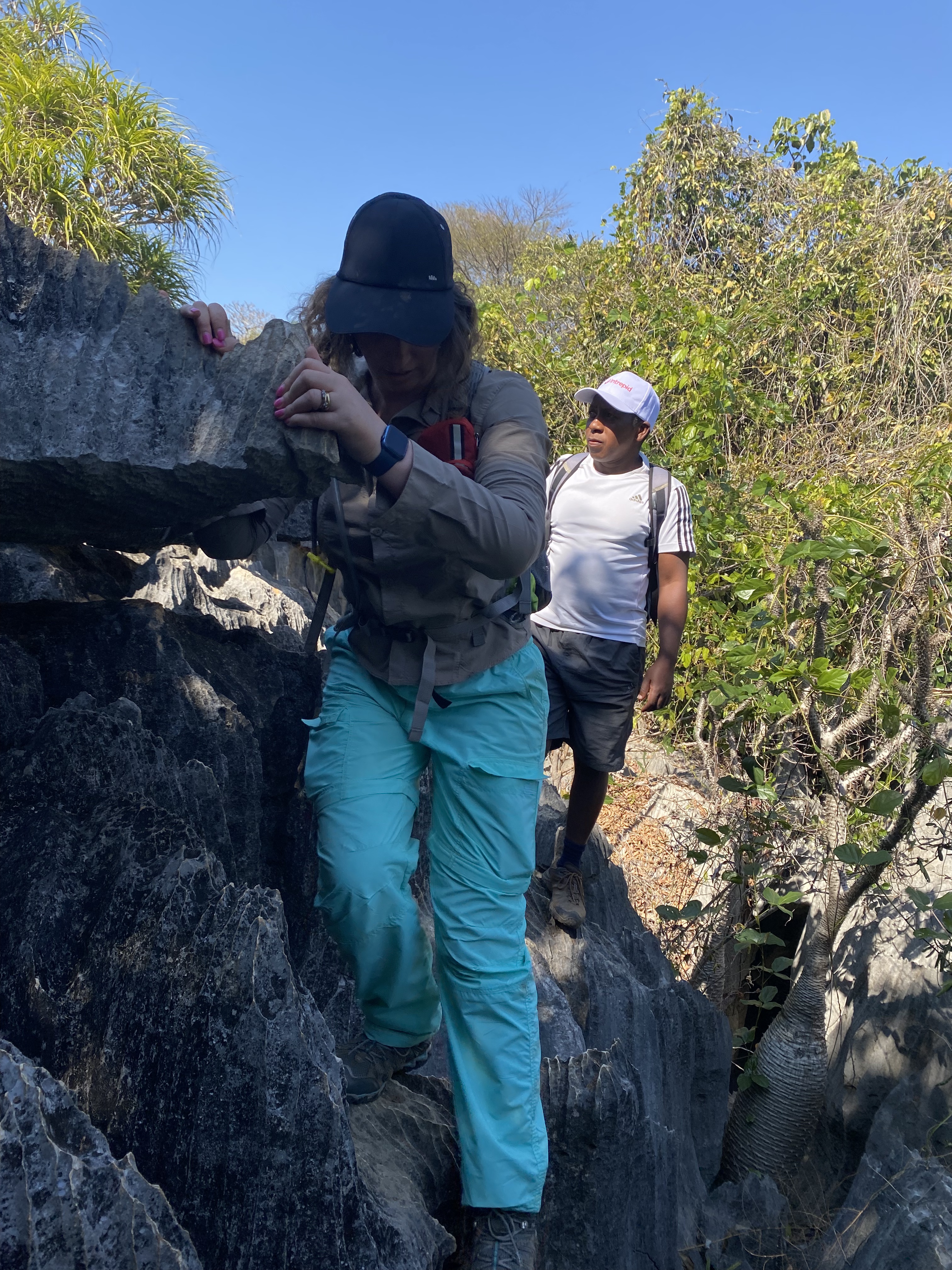
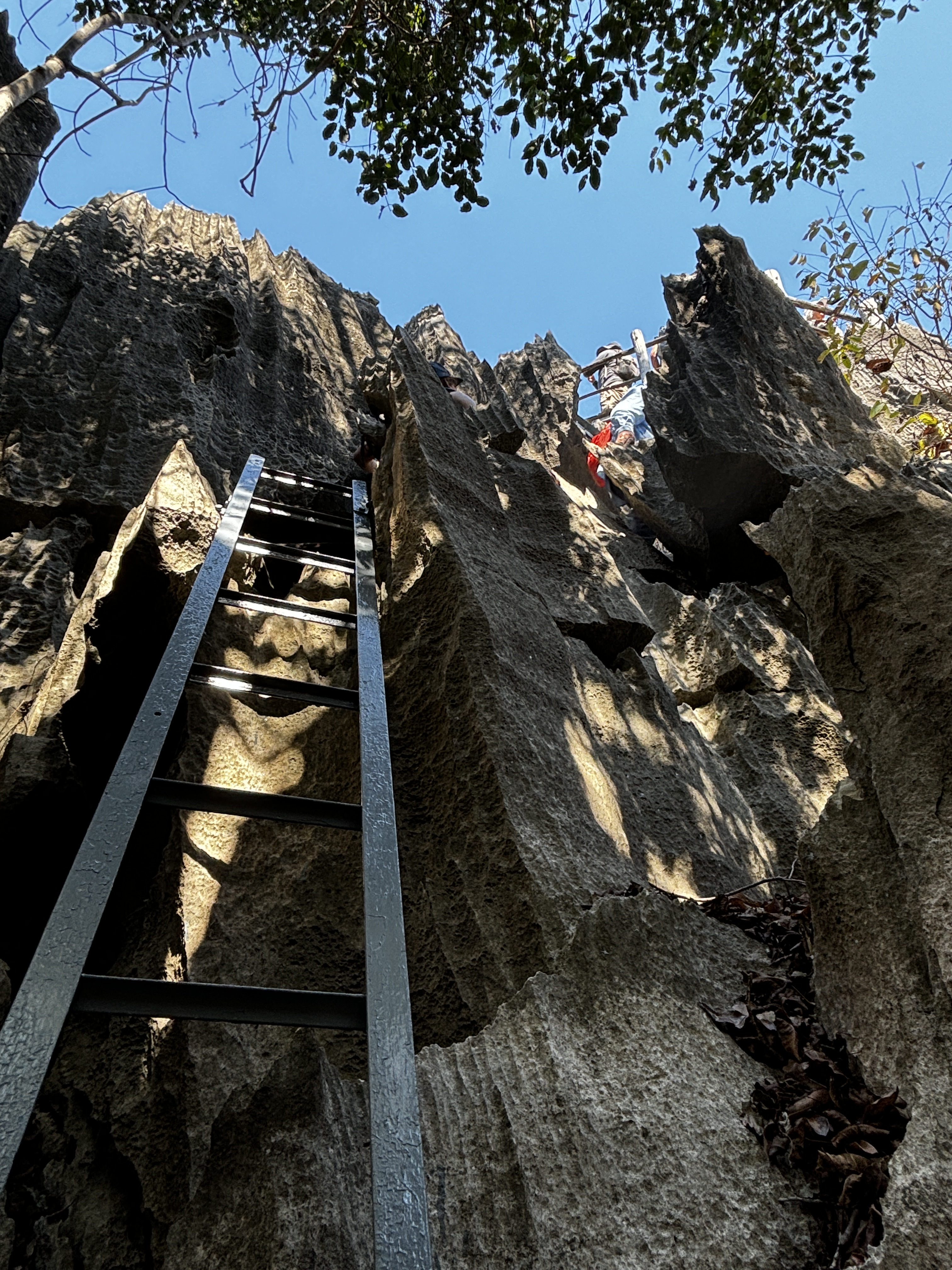
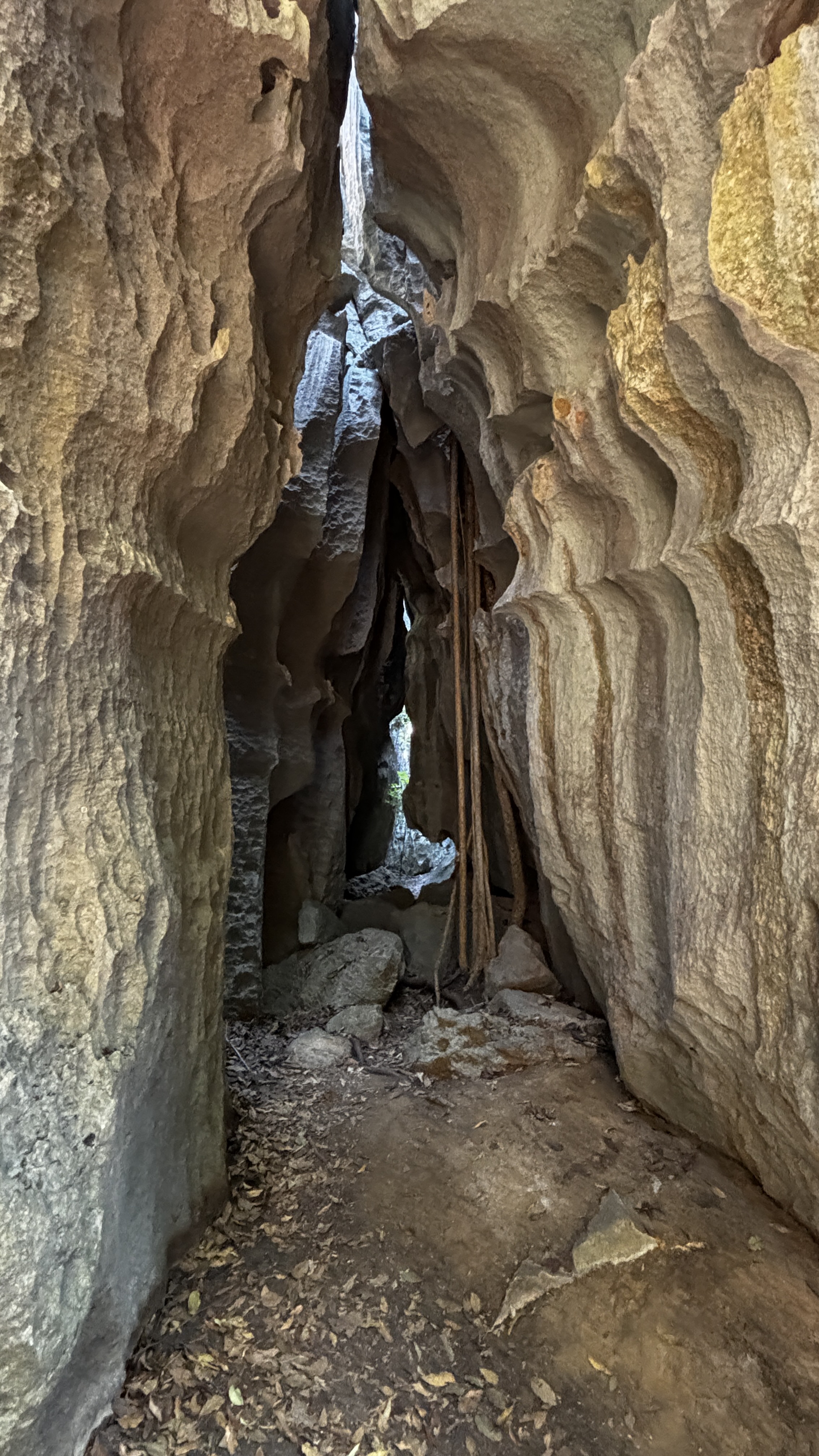
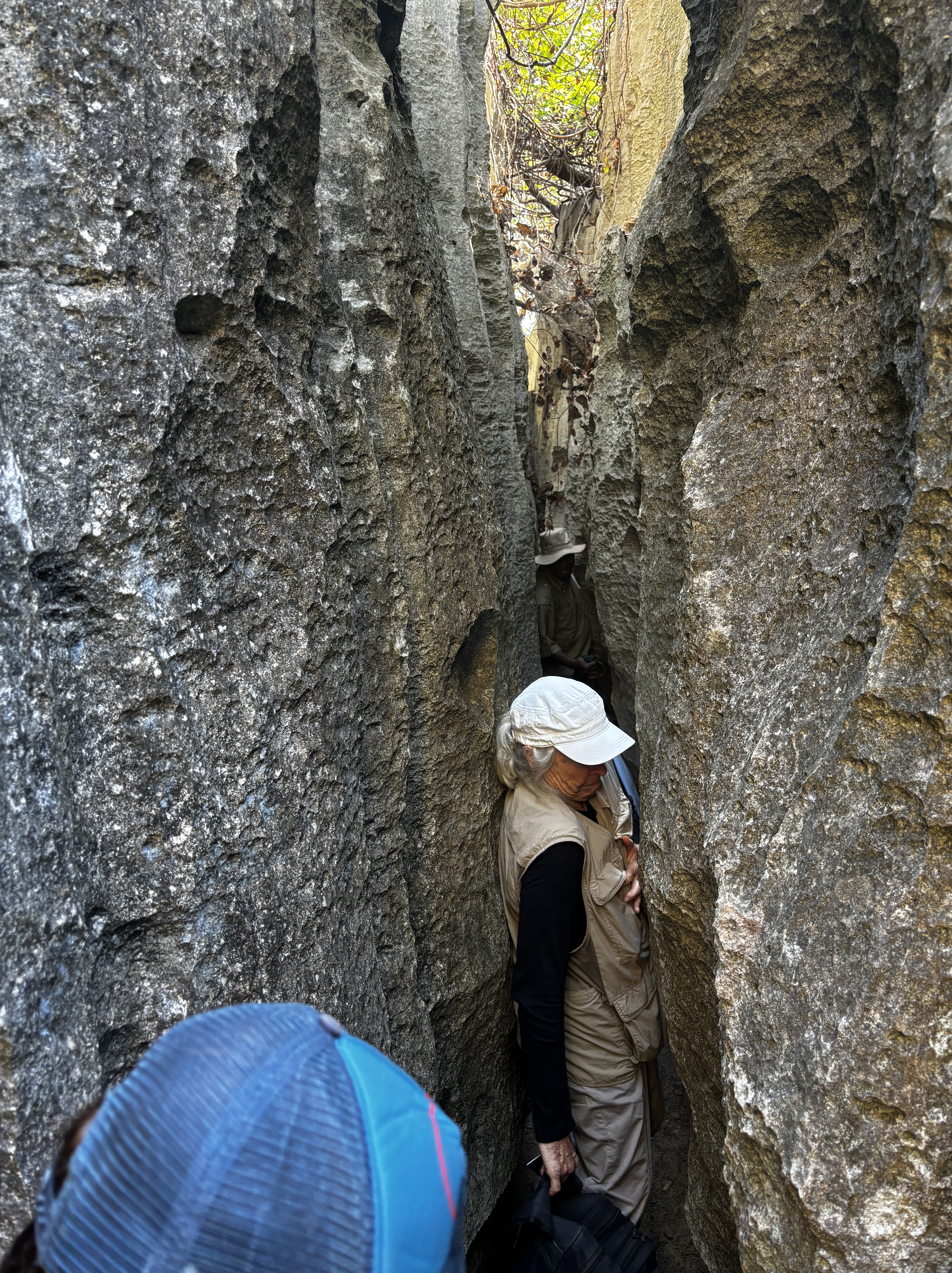
We went through narrow cracks in the rocks that tested a few of us with boobs. Certainly you couldn’t go through with a rucksack on your back. We ascended up ladders and descended down ladders too. Footholds had been bolted into the rocks and wooden bridges had been constructed over a few voids. Our guides watched our every move, helped us, encouraged us and judged us. For if they thought we struggled with the Little Tsingy they would strongly discourage us from doing the Great one. We all misjudged our 75 year old travelling companion. She was fit and aigle.








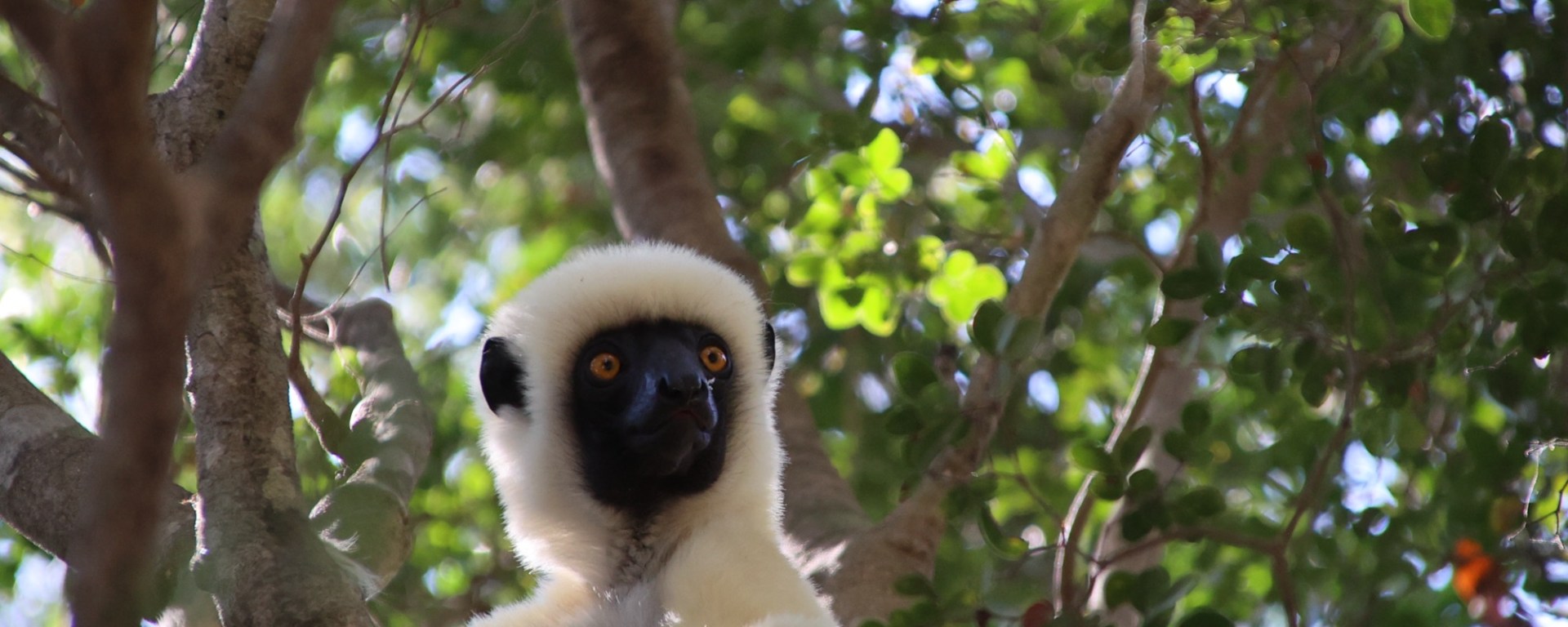
We had just descended down a ladder and gone round a corner back into the forest, when Barnabas stopped me and told me to come back and look up. Immediately I looked up and saw them. David was in front of me and he came back handing over his phone to the guide who was in front of him. Eventually the others came back – but they had taken their time because they were also treated to seeing rare wildlife.
Lemurs
We learnt that Madagascar while the 4th largest island in the world has the honour of being the oldest island in the world and as a result is home to unique flora and fauna including at least 110 species of lemurs.

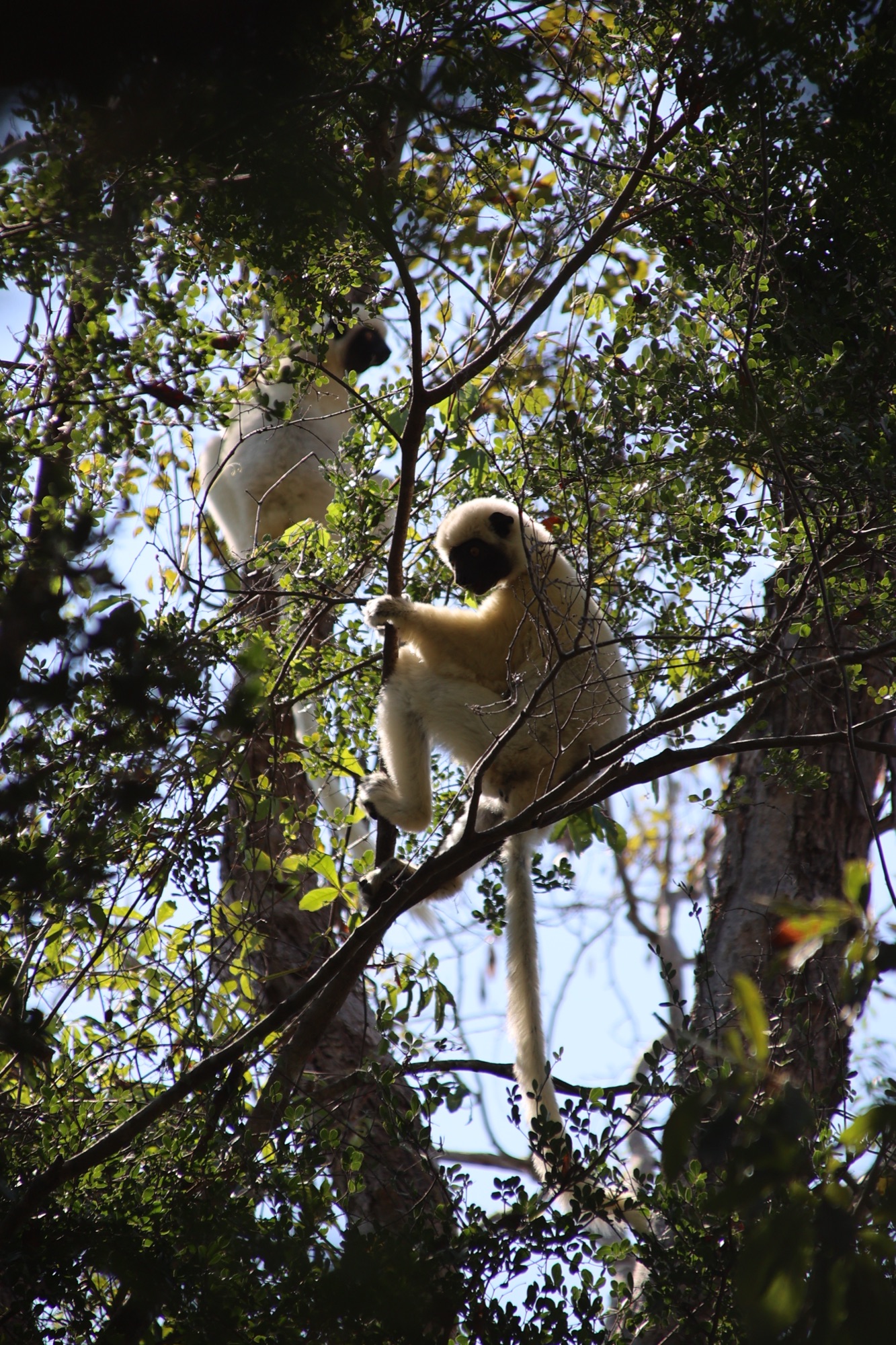
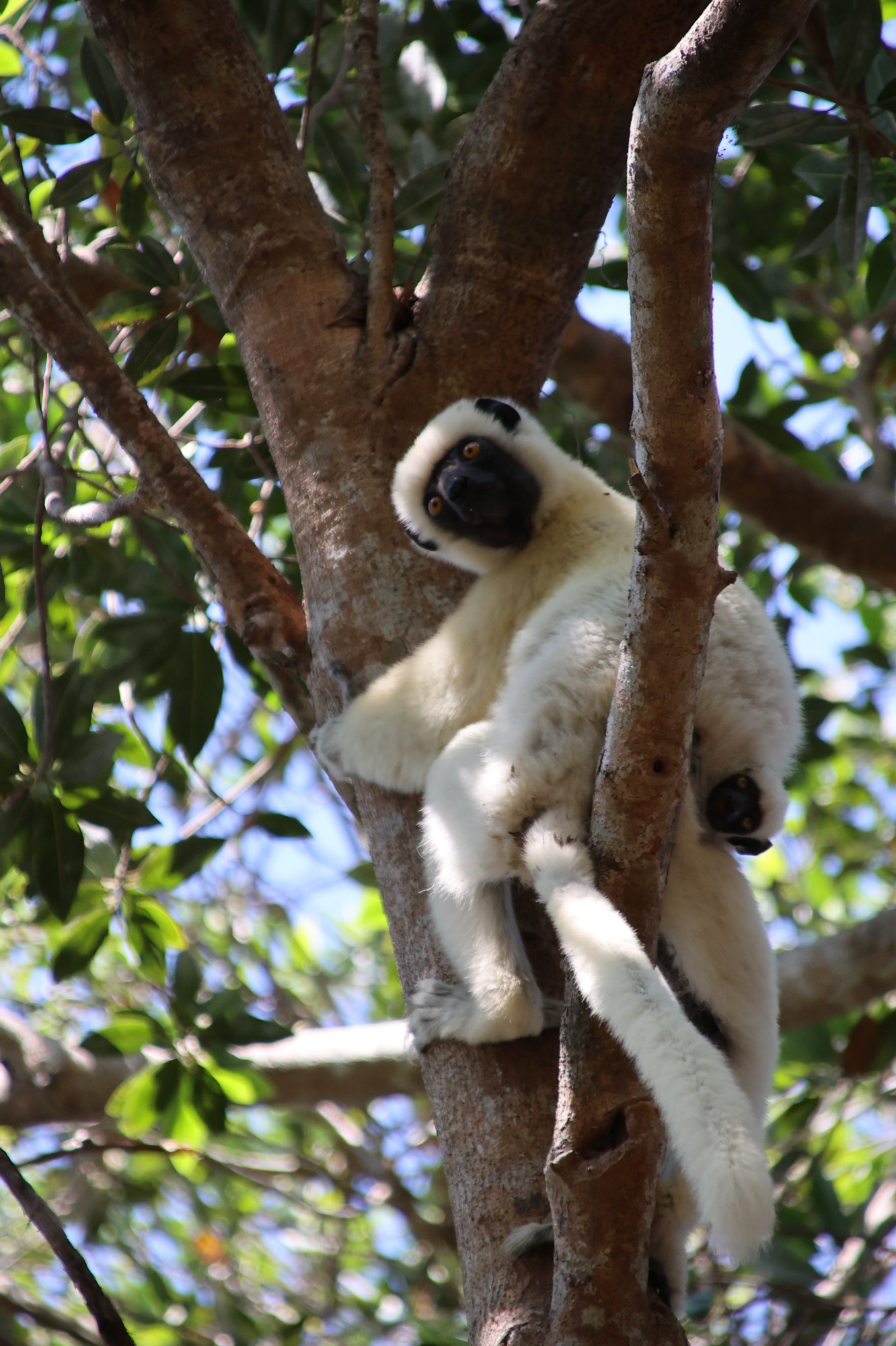
To take these photos was back breaking work given they were up in the trees, and it was tough not to have the camera shake, but I was happy with my baby lemur clinging onto mum’s back. We could have watched them for ages, and believe me I took more than three photos. Within my earshot, the guide of another group told his group that he regularly comes into the Little Tsingy and rarely sees these lemurs. We were very fortunate to see them up close and personal. They jumped from tree to tree keeping very upright and using their powerful hind legs as springs.
Eventually we moved on and clambered back down to the cool forest floor. Our guides and Barnabas didn’t tell anyone outright that they weren’t fit enough to do the Great Tsingy but there was a period of reflection for all.
The next day, we were up early (6am for 6:30 leaving), we had pre-ordered lunch and while some ordered a baguette with filling I had a couple of boiled eggs. I had no desire to carry a sandwich with me that would be warm and sweaty by the time I ate it. I filled up my water bladder with 2L of water and we all set off for just over an hour’s drive. We stopped at the ticket office to collect harnesses as we knew we there would be some parts of the Great Tsingy that require us to be strapped onto railings.
Janet was worried about her shoulder which would hamper the ability to pull herself up on it. Barnabas showed her photos of the terrain and the types of “climbing” that we would be doing. Sadly Janet reflected that she wouldn’t come. Her disappointment was clear. She stayed on the forest floor with Jon (who was still not 100%) and David. The others who had been ill the previous day were determined to do it, and Jen fuelled herself with Coca Cola. I had mused aloud the day before that I probably wouldn’t bring my big camera with me, but Barnabas told Henrik and I that we should have our cameras with us for the forest floor, but then put it away when we were on the Tsingy. Thank goodness we did…


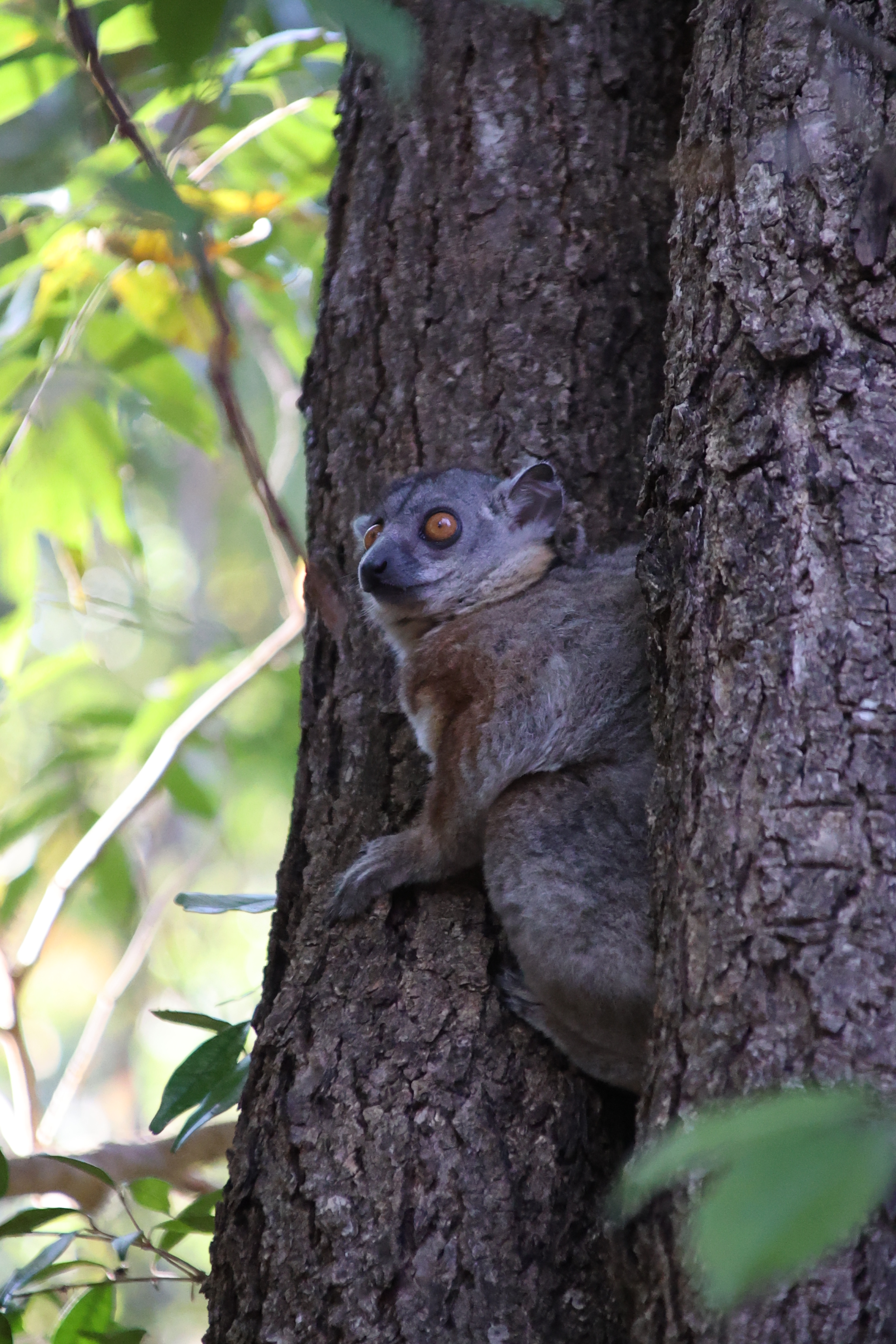
The Safikas, depending on species vary from being endangered to critically endangered. We were lucky to see another Safika and her baby among a conspiracy of lemurs. (The collective name for a group of lemurs – I love it!). These lemurs were not the first species we saw that day, instead our first two lemurs were seen nestled on two different tree trunks. The nocturnal red-tailed sportive lemur was still awake probably having had a heavy night.
Great Tsingy
Eventually we got to the area where Barnabas, one of our guides and eight of us separated from Janet and the others. We hoped that they would see more wildlife, but I am not sure they did. They got within spitting distance of one of the Tsingy viewpoints, but due to their lack of harnesses weren’t allowed to try and go up. They did get to an observation point and saw the Tsingy from afar, but it wasn’t quite the same. They also had the realisation that a viewpoint and observation point meant different things. I was gutted for Janet, and after we came back from the Tsingy we were all excited about what we saw, but we felt we hd to temper our excitement from the others. However, the three that hadn’t come, wanted to hear all about it, and so we told them. There were some difficult moments that Janet’s shoulder would have struggled with, particularly with the start and end points.
We used our harnesses for a couple of areas, sometimes clipping on with one strap, sometimes two. I laughed out loud though when I saw what Eleanor, my dad and Martin had done and worn on the same day back in Northern Ireland – they had gone to do the Gobbins Walk. The Gobbins is a cliff-face running from Whitehead to Portmuck Harbour along the east coast of Islandmagee, County Antrim, Northern Ireland. The Gobbins cliff path runs across bridges, past caves and through a tunnel and has, within the past 7 or so years been renovated and made safe to become a tourist attraction once more. They had to wear helmets and walking boots – compared to what we did – I would tentatively say that one place does health and safety well, and one place kind of gave a nod to health and safety. If we had fallen, none of us were sure how much our harness and carabiner clips would have prevented serious injuries. – sure we wouldn’t have fallen but crashing into the side of a sharp pinnacle had the potential to have been fairly catastrophic. But let’s not dwell on that. We all lived to tell the tale.
To state the obvious, the Great Tsingy was on a much larger scale than the little one.

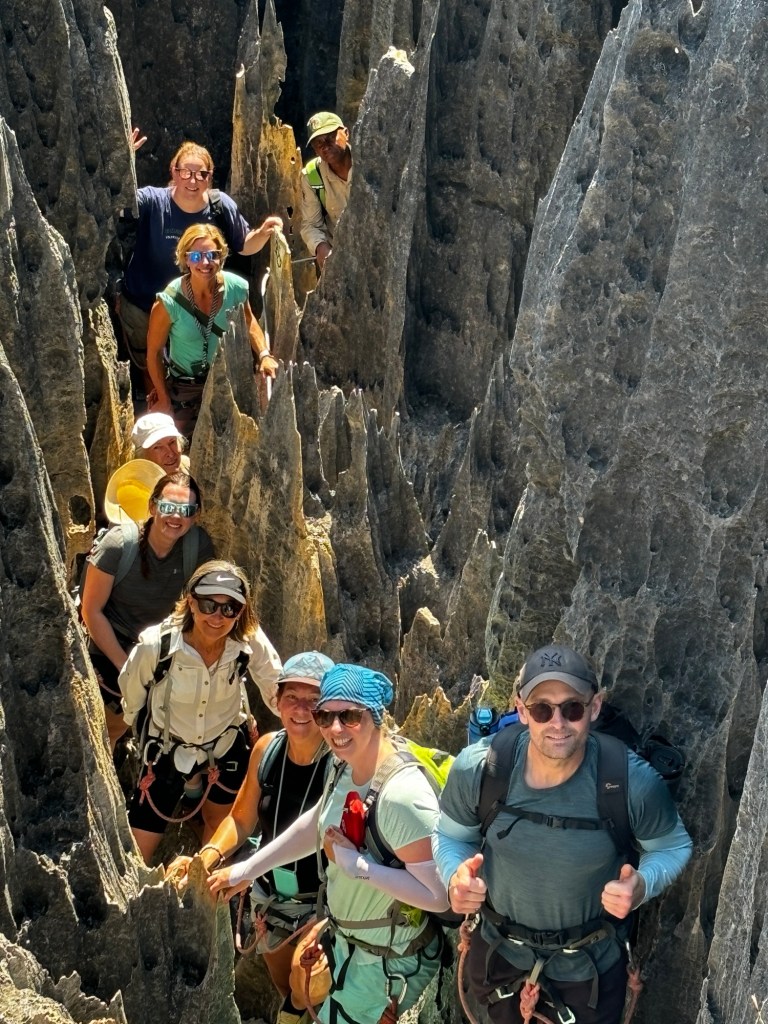

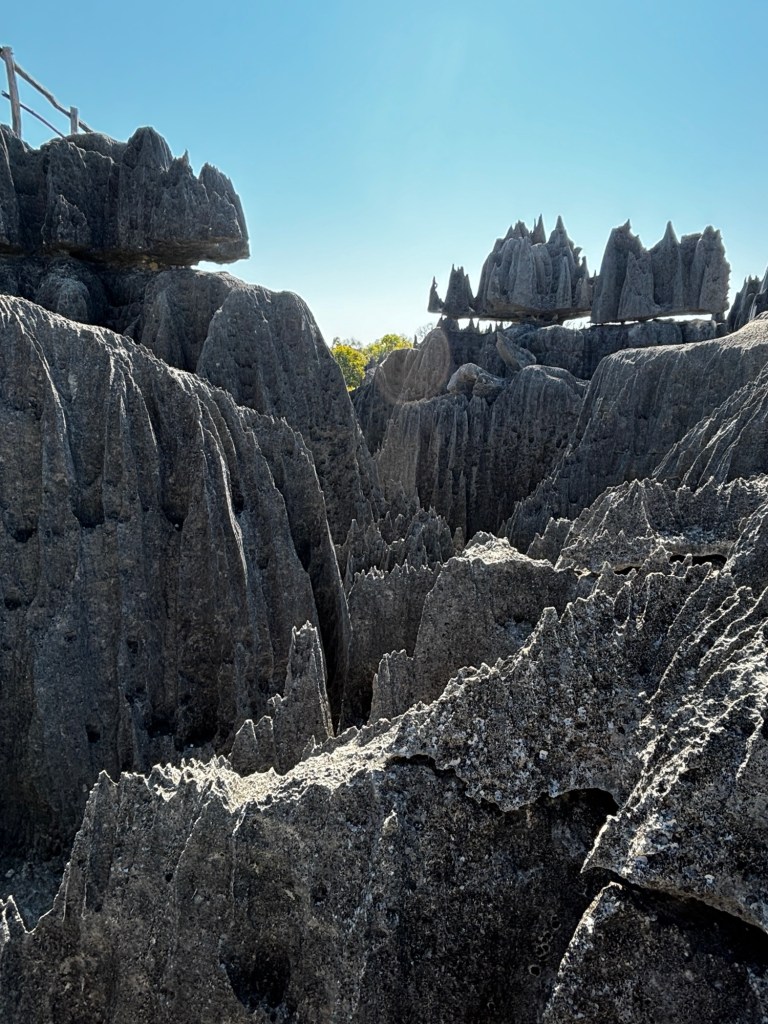
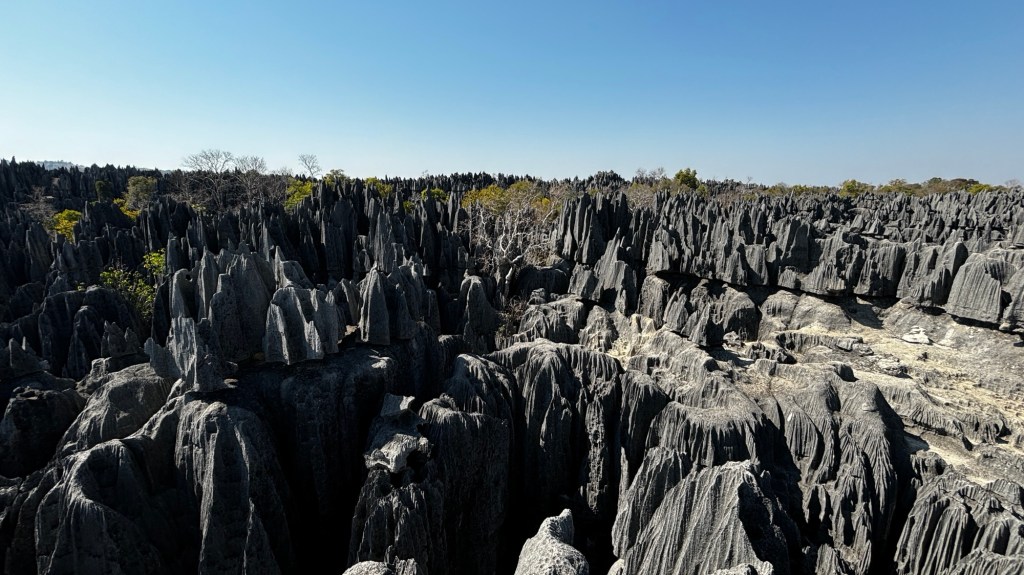


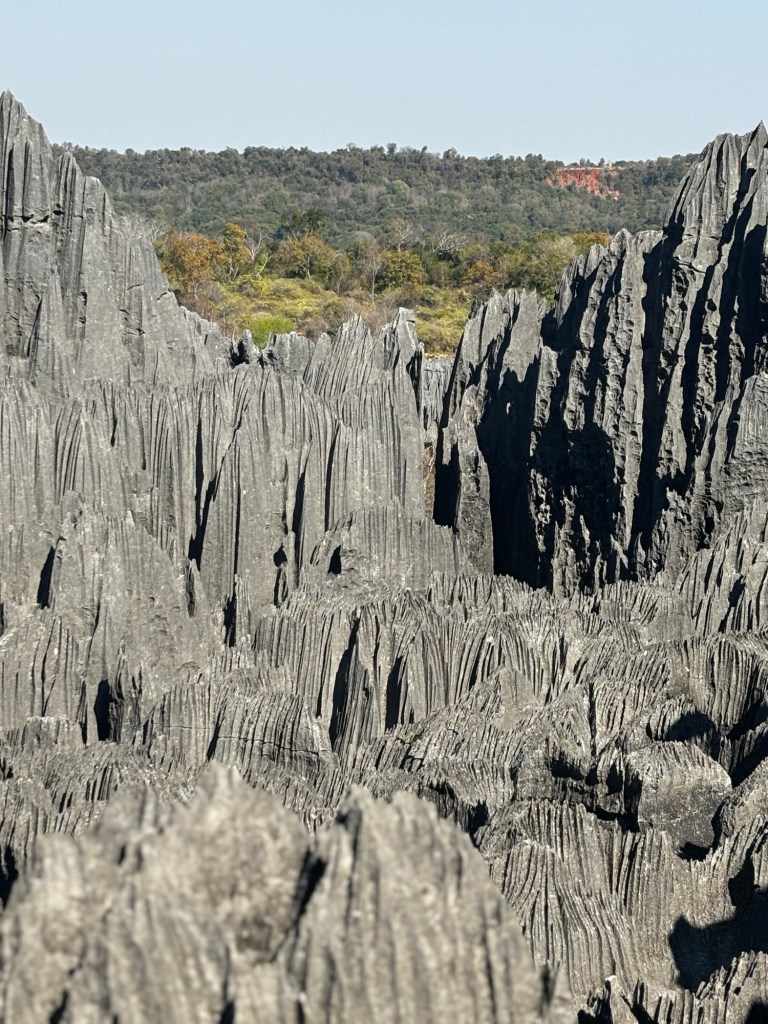


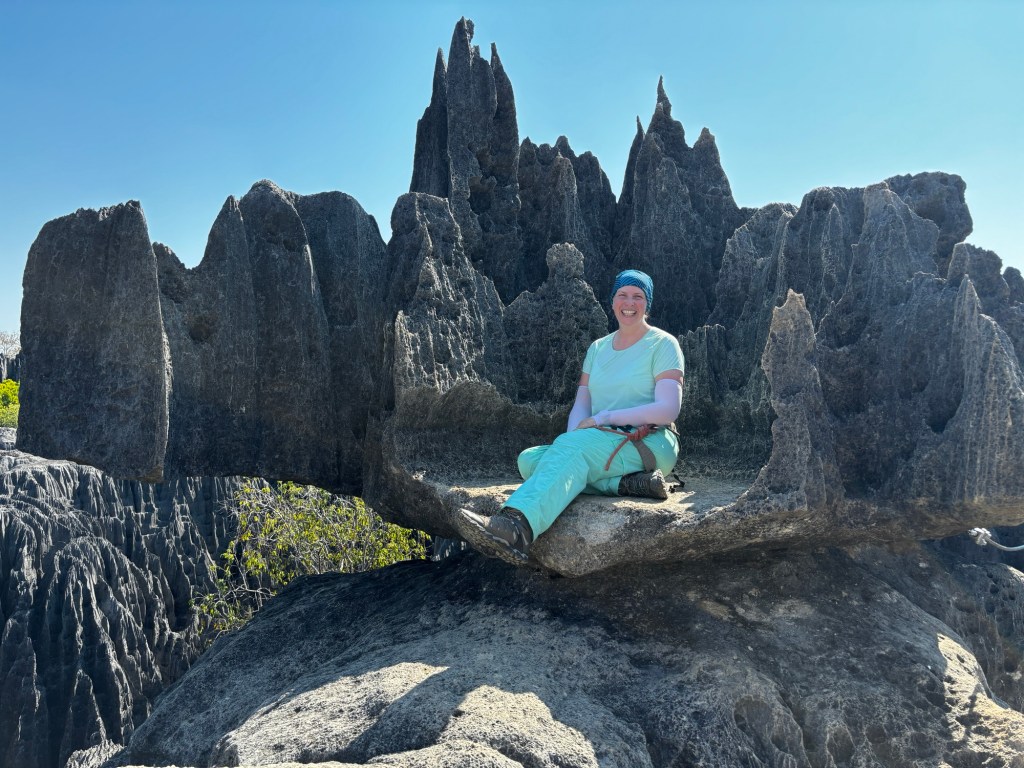
The Tsingy both Little and Great had had a few groups on them, but it wasn’t busy by any stretch of the imagination. We had initially been told it would take 8 hours at the Great Tsingy, and while we didn’t spend anything like that amount of time there, you could imagine that if it was teeming with tourists then the wait times to get up onto the narrow viewing platforms and to cross the bridge which you can only do one at a time would have been much much longer.
My phone was taken by Barnabas when we came to the bridge. He took a picture of everyone in our group crossing the bridge in the middle of the Tsingy. But as he took my phone – I don’t have a picture of the abyss that we crossed. The pictures of the bridge from the side don’t do it justice – but let’s just say the void was deep – but not as deep as Carrick-a-Rede rope bridge on the North Antrim Coast, Northern Ireland.


After the bridge we climbed back down and once we got back down to a shady cave we opened up our lunches. One of my hard boiled eggs had its shell cracked when I hadn’t quite bent over enough the accommodate by rucksack and my body to go through a crack, but those eggs tasted good along with some nuts that I had bought. The plan was going to be to have a late lunch back at the hotel but when we got back I opened up the crisps and felt I could wait for dinner.
Just before lunch, I felt very smug as I finished my 2L water bladder. Drinking water from the bladder is super efficient as there is a drinking tube coming from it that attaches through the rucksack. There is no need to keep stopping and getting a bottle out, unscrewing the top, drinking, screwing top back on and putting it back in the bag. Rather I was just able to suck on the tube that was hanging from my shoulder strap. Because it was so convenient I had kept myself hydrated – as Barnabas had said – when you feel thirsty you are already dehydrated! Thankfully someone had brought more water, and they let me fill up.
We left the labyrinth of the floor of the Great Tsingy and climbed up onto the grasslands. At the penultimate rung of the ladder the heat of the day hit us. It was as if someone had suddenly turned the sun on and we were blinded by the light and heat.
Back at the hotel we all headed for the pool. Barnabas sent through the lunch menu for Le Mad Zebu which we were going to the next day. We salivated over the menu, googled some ingredients and then ordered for the next day. Janet and I had massages booked before dinner which were delayed because the massage lady went home not realising we had booked for 6 and 6:30pm. She returned and gave me a relaxing but firm neck, shoulder and back massage. The little outhouse she used didn’t have a mosquito blind on the window and she kept the door open, there was no privacy but she was good at finding my knots and working on them during our limited time together.
The next day we left at 6:30am back on the car ferry and then on the sandy, bumpy road. We would have lunch the next day at 10:50am. Stay tuned for more! These couple of days at the Tsingys were highlights, the next day of highlights would be the next day. Who knew trees could be so fascinating…
 Crozier's China and our adventures
Wow Alison. What an amazing place. I know my knees would never have managed that Great Tsingy!! I’ve read about the unique flora and fauna, something I would love to see. Especially the lemurs!
LikeLiked by 1 person